Vagina Privacy Network
Cannes silver lion
2025
Background
In the current socio-political climate in the United States, women's fight for reproductive rights is no longer limited to courtrooms and clinics. From search histories to GPS data to direct messaging and texting, women’s online activity can and has been used as evidence to prosecute them in abortion-related cases. Digital privacy has become a form of self-defense now that reproductive choices are criminalized.
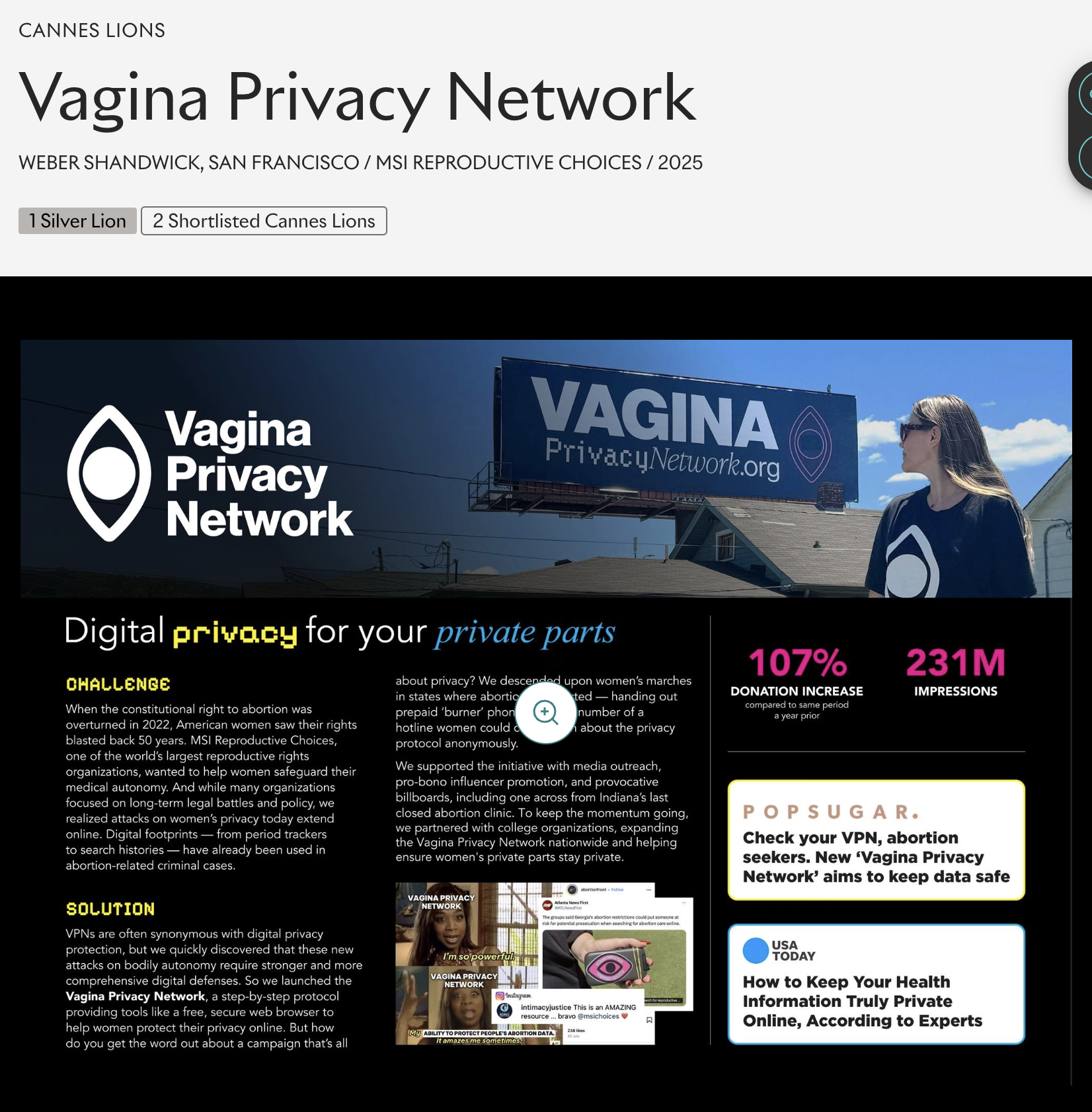
The Vagina Privacy Network used that unfortunate cultural insight to bridge the gap between women's digital footprints and their bodily autonomy. Going beyond mere advocacy, the campaign took action to help women protect themselves in one of the places they’re most vulnerable: online.
IDEA
TECHNOLOGY
Virtual Private Networks, more commonly known as VPNs, have long been foundational to privacy protection online. But after conversations with MSI’s digital privacy partner on this campaign, the Electronic Frontier Foundation, we realized that new attacks on bodily autonomy require a stronger and more comprehensive type of digital defense.
PRIVACY
So, we created the “Vagina Privacy Network,” a step-by-step protocol (available at VaginaPrivacyNetwork.org) that includes access to a free—and more secure— web browser, available to anyone who wants to keep their private parts private online. Other aspects of the protocol include using encrypted messaging, avoiding traceable payment methods like credit cards, and protecting yourself from location tracking in newer models of cars or through ridesharing services.
STRATEGY
TARGET AUDIENCE
American women in states where abortion has been restricted and potential donors.
INSIGHT
When reproductive choices are criminalized, digital privacy is self-defense.
STRATEGY
While many reproductive rights organizations concentrated their donation-driving campaigns on long-term legal and political efforts, MSI Reproductive Choices identified a critical (and practical) gap in the post-Roe world: The lack of education for women on how to protect their digital privacy.
Because today, digital footprints—from period trackers to search histories—can be used against women by the authorities, abusive partners, or anti-abortion groups.
But even the most well-known way of protecting digital activity, VPNs, are used by less than half of Americans, with women accounting for only a third of users worldwide. VPNs can offer a false sense of security in some cases, requiring a more robust solution for women whose bodily autonomy has been criminalized. And so, the Vagina Privacy Network was born.
—> https://www.vaginaprivacynetwork.org/